

Learn how to make herbal tea at home using fresh or dried herbs, including a simple lavender–lemon balm recipe and tips for creating your own blends.
Whether you enjoy herb tea for its rich, caffeine-free flavor and fragrance, or for the health benefits it offers, you can grow and use your own tea herbs. This article on growing an herb tea garden walks through some of the best herbs to start with.
Here, I’ll walk through how to make a simple lavender-lemon balm tea, which is easy, fragrant, and soothing. Toward the end, you’ll also find notes on other blends and slightly more involved methods.
Benefits of Lavender-Lemon Balm Tea
Both lemon balm and lavender have a calming, mildly sedative effect, according to Rosemary Gladstar and in my own experience. They’re often used to help with sleep, including insomnia and even nightmares.
Lavender may also help ease headaches, while lemon balm is known to support digestion.
Just as important, they taste good together. The scent and flavor blend into a sweet, fresh tea that’s especially nice at the end of a stressful day.
How to Make Lavender Lemon Balm Tea
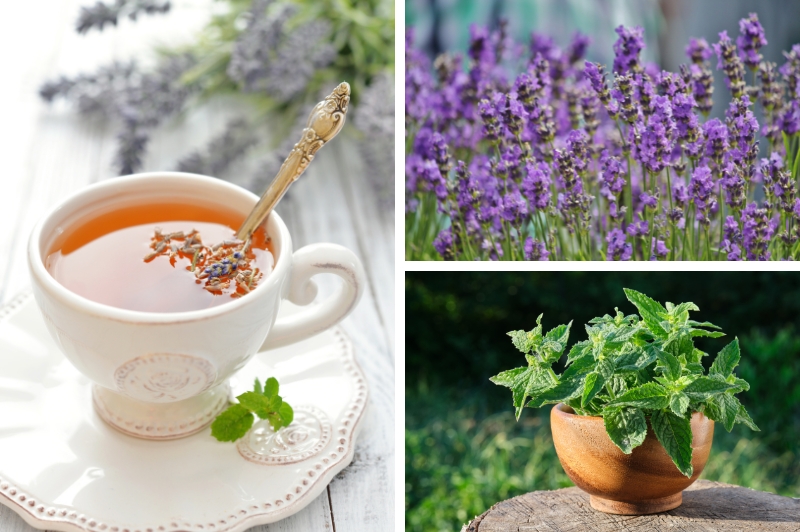
Harvesting and Preparing Your Herbs
Harvest lavender flowers just as they begin to open. I try to cut mine when only one or two of the tiny florets are open. You can use fully open blossoms, but Gladstar notes that their medicinal properties may be weaker at that stage. Cut the flower stalk just above the leafy part of the stem.
For lemon balm, use the leaves rather than the flowers. Pinch or snip off the tender tips of growing stems, taking the top 2 or 4 pairs of leaves. For good regrowth, cut just above a pair of leaves.
For fresh use, that’s all you need to do. You can rinse the herbs if they’ve been splashed with soil or treated with anything you’d prefer not to drink. Most of the time, I simply pick them and use them as they are.
Lavender is especially easy to dry for winter use. I put bunches of long-stemmed flowers into vases without water and let them air dry.
Lemon balm can be dried by hanging it in bunches, or by spreading the leaves out on a dehydrator tray or even on paper towels in a microwave. The leaves are ready when they become brittle.
Simple Tea Recipe
This tea is very easy to make.
If you have a tea ball, fill it with lavender flower heads and lemon balm tips, then place it in a mug and pour in boiling water. If you don’t, simply place the herbs loose in a mug or teapot and pour in the water.
I use 2 – 4 tips of lemon balm and 4 – 6 lavender flowers per mugful of tea. Since both the herbs and personal taste can vary quite a bit, you may want to adjust. The National Geographic Guide to Medicinal Herbs suggests about 5 or 6 lemon balm leaves per cup as a starting point.
Let the tea steep for 5 to 10 minutes. If you’re using a tea ball, remove it when ready. Otherwise, strain the tea into your cup.
This is the method I use for a pleasant tea that also seems to have a real soothing effect. National Geographic suggests a 5 to 7-minute steeping time, while Gladstar recommends much longer steeping (20 – 40 minutes) when preparing herbs more strictly for medicinal use.
Herbal Tea Blend Ideas
I usually drink herb tea plain, but some people like to add honey, sugar, or maple syrup. I’m more likely to balance flavors by combining herbs pairing something naturally sweet with something more medicinal or bitter.
With a little experimentation, you can find blends that suit your taste. Here are a few I often use:
- Tips of mint sweetened with heads of purple clover make a pleasant tea for indigestion
- Sprigs of parsley, sage, rosemary, and thyme make a satisfying savory tea (I’m not sure sugar would help this one)
This second blend also has a range of traditional uses. The National Geographic Guide to Medicinal Herbs notes:
- Parsley for muscle aches and digestion
- Rosemary for headaches and tension
- Sage for coughs and colds
- Thyme for colds and respiratory support
Teas made from leaves and flowers can be prepared using the basic method above. Teas made with barks, roots, or berries require a slightly different approach.
When I have a cold, I make a tea with dried marsh mallow roots and elderberries from my farm, along with licorice root (for sweetness) and lemon balm leaves.
I put the sliced roots and dried berries into a saucepan with 2 – 4 cups of cold water, bring it to a boil, and let it simmer for five minutes. Then I turn off the heat, add the lemon balm leaves, and let everything steep for another five minutes before straining into a jar.
Frequently Asked Questions
Are Herbal Teas Safe to Drink?
I’m not a medical expert. The health benefits I’ve mentioned are ones I’ve seen described in sources I trust, and many of these teas have been helpful to me personally.
I haven’t come across warnings about these particular herbs for people in good health, but those with specific conditions may want to check with a doctor or consult a reliable reference for possible interactions or side effects. Some herbs can have stronger effects than others.
I am aware of two possible concerns. The National Geographic Guide to Medicinal Herbs notes that people with gastroesophageal reflux disease or hiatal hernias may want to avoid mint. And while not exactly a risk, I find that lavender and lemon balm make me pleasantly sleepy. I wouldn’t drink them right before something that requires full focus.
Fresh vs. Dried Herbs: What’s the Difference?
Most herbs can be used either fresh or dried.
If you’re measuring by volume:
- Use about twice as much fresh herb as dried
- Or half as much dried herb if the recipe calls for fresh
If you’re counting leaves, sprigs, or flower heads, the number usually stays the same.
Summary
You can make your own herbal tea for health, for flavor, or simply for the enjoyment of it. I’ve shared a few simple blends here, but there are many more to explore. You can find them in herbal guides or experiment and create your own favorites.